If you’re like many homeowners, a bathroom remodel is at the top of your home improvement wish list. Whether you bought your home knowing that you would eventually want to tackle that project, or whether you’ve lived in your home for years and have grown dissatisfied with it over time, this guide will help walk you through the planning process.
Start With A Vision
[sixcol_three]
Before you begin your bathroom remodel, take time to determine your wants and needs. Costs, style, layout, and many other details will be determined by the bathroom you envision. The answers to the following questions will help you bring your dream bath into focus, and frame the scope of your project.
1. What type of bathroom are you renovating? Costs and style will vary based on the bathroom type.
2. What do you like about your current bathroom? Identifying the elements you love or want to keep will help narrow the scope of work and inform the style and motifs of your new bath.
3. What would you like to change the most? Determine the highest priority changes you’d like to make.
4. Do you plan to change the floor plan or keep the layout the same? Costs and timelines can vary widely depending on whether you are making cosmetic changes or adjustments to the structure and plumbing.
5. Who will be using this bathroom? Layouts and functionality should be tailored to the needs of the user, whether they be adults, children, or the elderly.
6. Will multiple people be using the space at the same time? If so, you may want to consider expanding the floor space, including another sink or creating additional entryways.
7. What bathroom activities should be done in a private space? Nooks or separate compartments within a shared bathroom can help create a sense of privacy.
8. Do you want a bathtub, and if so, do you prefer it to be separate from the showering area? Separating the two spaces adds an element of luxury, but will require a larger footprint and will increase costs.
[/sixcol_three]
[sixcol_three_last]
Once you have a broad vision for your new bathroom, identify the specific activities you’ll do in your bathroom, the amenities you’ll need, and how much space you’d like to allocate for storage.
[threecol_one]
Activities
Washing hands
Shaving
Brushing Teeth
Trimming
Make-up
Drying hair
Skin care
Washing body and hair
Soaking
Laundry
Dressing up
Skin care
Lounging or relaxing
[/threecol_one]
[threecol_one]
Amenities
Electric Toothbrush
Electric razor
Blow dryer
Curling Iron
Scale
Music player
TV
Towel warmer
Washer and Dryer
[/threecol_one]
[threecol_one_last]
Storage
Makeup
Shaving tools
Hair grooming
Cleaning supplies
Bath towels
Medicine
First Aid
Linens
Bathroom Tissue
[/threecol_one_last]
[/sixcol_three_last]
Layouts and Designs
[fourcol_two]Now that you have a better idea of the activities and amenities your bathroom will need for its users, consider the placement of these components in a floor plan.
The following sample floor plans can help you think through your layout. Depending on your budget and whether you’re working within a limited square footage, you may need to adjust the location of plumbing fixtures and get creative with your design.
[/fourcol_two]
[fourcol_two_last]
[box]PRO TIP
Remember that some elements of your renovation may require additional structural logistics. For example, vintage cast iron and steel clawfoot bathrooms — popular in styles from traditional to rustic — are exceptionally heavy, even when not filled with water. Tiles, floor warming infrastructure, and other fixtures can also add a significant amount of weight and may require structural reinforcement, especially in a second-floor bathroom.[/box][/fourcol_two_last]
Half Bath or Powder Room
A half bath, also known as a powder room, is the most basic bathroom with only two plumbing fixtures: a toilet and a sink. Half baths are usually located in the public areas of the home, particularly near a living area or off a main hallway.
[fourcol_two]

[/fourcol_two]
[fourcol_two_last]

Installing a full vanity is an option with a slightly bigger floor plan. The long counter has more space for hand towels or other guest amenities above the counter, and provides storage space underneath.
[/fourcol_two_last]
[box]
If you’re planning on converting a small space into a powder room, consider the following:
- Install a narrow or small corner sink to comply with fixture clearances
- Use mirrors to increase the appearance of the room
- Install a sliding door instead of a hinged door
[/box]
Three-Quarter Bath
[twocol_one]

[/twocol_one]
[twocol_one_last]
While a 3/4 bath doesn’t include a tub, it rounds up to a full bath when calculating the number of bathrooms in a home. The minimum size for a three-fixture bathroom is typically around 5’ x 7’, and increasing to 8’ x 8’ allows space for the storage of linens or cleaning supplies.
This economical and popular layout uses the ‘common plumbing wall’, or keeps all fixtures on one wall to reduce costs.[/twocol_one_last]
Full Bath
Full baths have four fixtures, although many bathrooms combine the shower and bathtub into one. Layouts can vary drastically based on the needs of the users, the location of the bathroom, and the space and budget available.
[twocol_one]

A combination shower/tub is a good choice for most baths where separate showers are not needed and accessibility for the elderly is not a concern. A double sink accommodates multiple people, and the end wall of the tub helps to separate the toilet area for added privacy.
[/twocol_one]
[twocol_one_last]

The Master Bathroom, also known as an Owner’s Suite, tends to be more spacious with separate bathing and showering areas, and often include some luxe amenities, such as a double vanity or a grooming station. Consider placing the bathtub by a window for nice views while soaking.
[/twocol_one_last]
Design Guidelines
Take note of recommended design guidelines and clearances to plan a bathroom that is ergonomic and functional. Bathroom codes vary by locality, and while the code may set minimum clearances, having extra space is usually better.
[twocol_one]
Toilet
12” from the center to the end of a tub
15” from the center to the side of a tub, adjacent wall, shower stall, or lavatory
Leave at least 21” in front of the toilet (30” is recommended)
Lavatories
15” from the center of a sink to an adjacent wall or shower stall
Allow 36” between the center of two lavatories in the same countertop
Leave at least 8 inches from the edge of a sink to the end of the counter
21” in front of the lavatory
Backsplashes should be roughly 8 inches high
[/twocol_one]
[twocol_one_last]
Showers
34” x 34” minimum width and depth of a square shower stall
44” of space for a hinged shower door (should swing out)
36” of space in front of a sliding shower door
Tubs
The standard size of a tub is 30” width by 60” length
Fixture Heights
26” from the floor for toilet paper holders
48” from the floor for a towel bar
[/twocol_one_last]
Plumbing
Plumbing requirements for your new bathroom are impacted by the bathroom’s location, ventilation needs, supply lines, drainage lines, and many other factors. In addition, needs may vary by who is using the bathroom on a regular basis.
A master bathroom may include separate shower and tub, two vanities on different sides of the room, and a separate water closet in order to allow two homeowners to use the space simultaneously. The requirements for that type of layout will be far more extensive than those of a simple powder room or guest bathroom.
An Owner’s Suite bathroom may also include add-ons like a sauna, steamroom, large spa shower with multiple fixtures and seating, a jetted or soaking tub, and other options. These will require far more extensive installation and labor costs than more straightforward styles.
[box]PRO TIP
If you’re adding a completely new bathroom on a budget, keep all plumbing along a single wall to minimize material and labor costs. Remember that the more walls that have plumbing, the more expensive it will be. If you’re remodeling an existing layout, keep structural and plumbing changes to a minimum.[/box]
Design Elements
Vanities
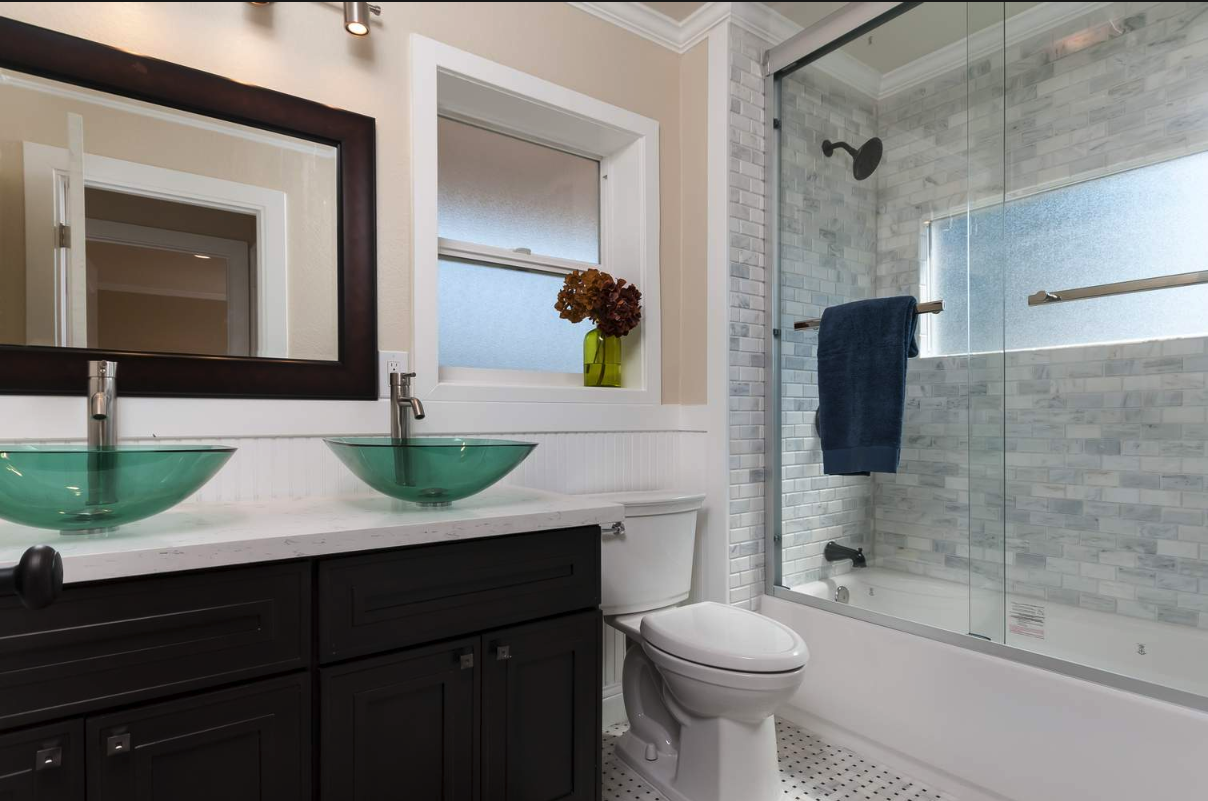
While we frequently think of vanities in terms of simple utility, a vanity may be one of the most stylish focal points of your bathroom. Cabinet or furniture-style vanities, farmhouse sinks, and high-concept faucets can all contribute to making a major decorative statement.
While double vanities are often thought of as a Master Bath element, they work equally well in a shared child’s bathroom, bringing order to hectic nightly bath times and morning routines. In addition, built-in step stools and child-friendly faucets can vastly increase their utility, making them a popular upgrade.
Tile
There is a vast variety of tiling, from always-popular subway tiles to glass to natural stone, marble, and slate. In addition, decorative tile elements may be incorporated as an accent in the floor, walls, or shower surfaces.
Flooring
Tile, stone, laminate, and vinyl flooring options are popular in bathrooms and can be used to create a variety of looks. Proper installation is the key to ensuring both the utility and style of your flooring, since gaps, seams, and other errors can invite water damage and other problems.
Wood floors and carpeting should, in most cases, not be used in a bathroom, though they may be options in a powder room where there is less moisture and less frequent use.
Fixtures
The choice of fixtures is one of the most important in determining the overall style of your bathroom remodel. Because they come in a variety of metals, polishes, and styles from antique to ultra-modern, fixtures can change the look of an otherwise neutral backdrop significantly. In fact, if you are thinking of a smaller, more cost-efficient bathroom redecorating project, you may want to simply change out faucets, towel bars, and other small elements. These may give your room a whole new look for minimal financial outlay.
Lighting
Lighting has a significant impact on the utility of your space. Well-thought-out lighting at a makeup or shaving mirror is a definite plus. For high style, a beautiful chandelier can be at home in almost any bathroom, from the most luxurious master bath to a shabby-chic powder room. In addition, a bathroom is a popular place for a skylight, especially in a spa-style or contemporary bathroom.
How Much Does A Bathroom Remodel Cost?
By this time, you probably have a clearer image of your dream bath and some ideas around materials and finishes. Of course, for most people, budget will be a major consideration.
The good news? As we’ve shown, there are many factors that impact cost. That means that you can adjust many different elements in order to arrive at a budget that works for you. You can also get the look you want with fixtures and other elements at a variety of price points. That means you can get an upscale look even without a penthouse budget.
Average Cost for Remodeling a Bathroom
Cost estimates vary widely based on the bathroom’s size, how much structural and plumbing work is needed, the bathroom’s current condition, as well as the grade of interior finishes and materials.
The following scales represent average costs for different types of bathrooms, based on national averages and other data submitted on BuildZoom. On the lower end of the spectrum are minor renovations which may include repainting and the replacement of fixtures, mirrors, and lighting. Major renovations include changing the layout or footprint of the bathroom, replacing vanities, and upgrading fixtures and finishes.
[threecol_one]
Powder Room
Minor Renovation: $5,000
Major Renovation: $9,800
[/threecol_one]
[threecol_one]
Guest or Child’s Bathroom
Minor Renovation: $9,500
Major Renovation: $14,300
[/threecol_one]
[threecol_one_last]
Owner’s Suite Bathroom
Minor Renovation: $13,000
Major Renovation: $20,000
[/threecol_one_last]
How to Choose a Contractor
Selecting a reliable and knowledgeable contractor is perhaps the most important step in any remodel.
- Have an idea of what you want before you begin. Search design books, consult with a decorator, or have a trusted friend help you come up with a sense of the look and materials you are going for. Being able to communicate your vision will help
- Create a budget (and leave some wiggle room). Get a sense of how much you want to spend, but don’t overextend your budget. Moving fixtures, flooring, or wall coverings can reveal the unexpected — leave some room for needed repairs or changes to the plan.
- Work with a contractor who knows bathrooms. If your contractor primarily works on large scale new construction projects, a small bathroom remodel may not command all of his or her attention. If your contractor specializes in exterior renovations, they may struggle with the logistics of an interior remodel.
- Set clear expectations. Ensure that you and the contractor have a clear idea of the scope of the project, the budget agreed upon, and the time frame, during which work will occur.
- Don’t pay more than 10% of the budget up front unless there are expensive, custom materials that need to be ordered. Discuss actions which, when complete, will trigger process payments.
- Once you’ve made decisions, try to stick with them. Change orders are a sure way to blow your budget and your timeline, requiring not just lost time but also duplication of materials and labor.
[box]
Would you like some help?
BuildZoom can help you connect with the right contractors, compare your bid and eliminate your risk.
Tell us a little about your project to get started.
[/box]