[fivecol_four]

[twocol_one]
< Step 9: Meet contractors for a walkthrough
[/twocol_one]
[twocol_one_last]
Step 11: Hire a contractor >
[/twocol_one_last]
Getting proposals
[twocol_one]
Receiving proposals can be one of the most exciting and highly anticipated moments for a homeowner. After months of planning and designing, they will finally be able to put a price tag on their new home!
The reality is that getting an accurate ‘price tag’ on a home is not that simple. The first thing you may notice when you flip to the grand total of each proposal is that prices can vary considerably. One estimate may come in at $550K, the second at $620K, and the third at $480K. How can estimates for the same project differ so much?
The answer is that you are not purchasing a single standard product, but rather a complex interaction of hundreds of individual materials, services, and finishes. The thick set of structural drawings you provided to the contractors may appear to describe your project in great detail, but there are many elements that are not self-evident, and these undefined variables can have a big impact on the total cost of your home.
[/twocol_one]
[twocol_one_last]
So how do you know which proposal to choose? The way to evaluate whether a proposal is complete and offers good value for the price is to dig into the details — down to each line itemization. The adage ‘the devil is in the details’ rings particularly true for evaluating estimates.
[box]
Objectives:
- Determine whether the totals are aligned with your budget
- Determine the completeness of each proposal
- Compare costs between contractors
[/box]
[/twocol_one_last]
[/fivecol_four]
[fivecol_one_last]

[/fivecol_one_last]
[fivecol_four]
What’s in a proposal?
[twocol_one]
There is no standard format for a proposal and each builder’s submission often look nothing like the others. Some may create their own template, while others may use third-party software or BuildZoom’s proposal template. Most likely you will receive the document in person or via email, and if you are a BuildZoom user, through your project dashboard. If a contractor sends you their proposal digitally, it can be helpful to review the estimate together over the phone.
[/twocol_one]
[twocol_one_last]
[box]
If the proposal doesn’t provide enough granularity in the scope of work, prices, exclusions, or allowances, don’t hesitate to ask for more details.
[/box]
[/twocol_one_last]
[twocol_one]
The Elements of a Proposal

[/twocol_one]
[twocol_one_last]
1. A cover page or header
Most proposals will include a cover page or header which will include basic information about the contractor, including their Contractor State License Board (CSLB) number and contact information. It’s helpful to have the date the document was created as you may generate several versions of the estimate as you adjust the scope of work and negotiate prices. Some proposals may also indicate a date until which the estimate is valid. Remember that market prices on equipment and labor can fluctuate, so the contractor may not be able to commit to a price for more than a few weeks.
[/twocol_one_last]
[twocol_one]
2. The 16 divisions of construction
Estimates are often grouped into “16 Divisions of Construction,” a standard for organizing building specifications as defined by the Constructions Specification Institute (CSI). The standard has been adapted over the years, but the categories you will see in your proposal will most likely resemble the 16 Division Standard. Not all builders will follow this format, so just ensure that the relevant categories are covered and are described in a fine level of detail.
Division 01 — General Requirement
Division 02 — Site Construction
Division 03 — Concrete
Division 04 — Masonry
Division 05 — Metals
Division 06 — Wood and Plastics
Division 07 — Thermal and Moisture Protection
Division 08 — Doors and Windows
Division 09 — Finishes
Division 10 — Specialties
Division 11 — Equipment
Division 12 — Furnishings
Division 13 — Special Construction
Division 14 — Conveying Systems
Division 15 — Mechanical/Plumbing
Division 16 — Electrical
[/twocol_one]
[twocol_one_last]
3. Itemization
All of the tasks and materials required should be listed under its respective division. The more detailed the list, the better. If the items are not descriptive enough, ask the contractor for specifics such as unit costs or model numbers. This will help you better compare prices apples-to-apples, and identify any items that is included in one proposal and missing from another.
[box]
Check the itemization in your proposal to see how carefully the contractor reviewed your drawings and how closely it reflects the topics addressed in your walkthrough. You want the most accurate estimate for your unique project, not a general cost estimate for a typical house.
[/box]
[/twocol_one_last]
[fourcol_two]
4. Allowances
It’s best to decide on as many materials before you sign a contract, but often times final selections are made during the construction phase. An allowance is a ‘placeholder’ for the items that you may want to choose later, such as tiles, lighting, or cabinetry. They can be calculated for each division, or grouped into a single line at the bottom of the proposal, and the actual costs are balanced at the end of the project. Make sure labor for installing these items and materials are included in the base contract.
[/fourcol_two]
[fourcol_two_last]
[/fourcol_two_last]
Aligning your proposal with your budget
[twocol_one]
Unlike a contract which is a binding and static agreement, a proposal is still a dynamic document where both the scope of work and the prices charged can be adjusted. Take this opportunity to review every item in each of your proposals and make any necessary changes. You can and should negotiate the first estimates you receive, as contractors often anticipate to be negotiated down a bit.
If a proposal is over your target budget, one way to bring the total down is to delve into what items may be inflating your costs and find substitutes that are more economical. For example, a contractor may estimate 30K for custom cabinetry, but if the 10K pre-fabricated cabinets are good enough, ask to have them replaced.
It is not uncommon for architects to over-design a homeowner’s plans. After all, their main priority is to design to your vision and requests, not to ensure it can be executed within your target budget. If the proposals you receive are consistently over budget, there’s a good chance you need to reign in the scope of work.
[/twocol_one]
[twocol_one_last]
Don’t try to squeeze a $600K project into a $500K budget — there is no such thing as getting more than you pay for. Remember that you should leave some buffer room for changes, delays, and other unforeseen problems. A 10% cushion can help ensure you’ll stay within your budget, so if you really can’t spend more than $500K, sign a complete contract that’s no more than $450K. For most homeowners, the proposal is reworked multiple times before going to contract, so you don’t need to jump into an agreement that doesn’t work for you.
[box]
Be respectful of the contractor’s time. Reworking your proposal should be guided by a clear vision for what you want and can afford — not your indecisiveness. Creating an accurate proposal for your new home build requires hours of reviewing your plans and lot limitations, as well as researching materials and costs. While most contractors will provide estimates for free, let them know in a timely manner if you don’t intend to hire them.
[/box]
[/twocol_one_last]
Comparing estimates
[twocol_one]
The lowest estimate is not necessarily the best. When you begin to compare your proposals, your initial reaction may be to start eliminating from the most expensive estimates. Be careful of disregarding these — the contractor who offered a higher price is not necessarily less efficient or overcharging you. It could be that their bid is more complete, and includes items and services that are omitted in others. They could also be using higher quality materials, which are invariably more costly.
Contractors are aware that cost is a principal concern for homeowners, and some may present a lower total price by leaving off undecided items or substituting for cheaper alternatives. Lowering prices makes a contractor more competitive and more likely to get hired, but you can be sure that you’ll be paying the difference in the end – either in the form of a change order or additional order.
It’s up to you to identify what could be missing by comparing each line item across proposals. If you notice any discrepancies, temporarily plug in the estimated costs from one proposal into the other as a placeholder so that they are more balanced.
[/twocol_one]
[twocol_one_last]
The phrase ‘apples-to-apples’ is often used to describe the ideal way to compare estimates — item by item, line by line. In reality, each proposal will look so different that ‘apples-to-picnic tables’ is perhaps a better description of the challenge at hand.
Comparing and making sense of a handful of unstandardized bids with different formats, price calculations, and degrees of detail can be frustrating and time-consuming. An ‘apples-to-oranges’ comparison may be the closest you’ll ever get to a perfect evaluation, but this process is crucial for setting your project up for success.
[/twocol_one_last]
Bid leveling with BuildZoom
[twocol_one]
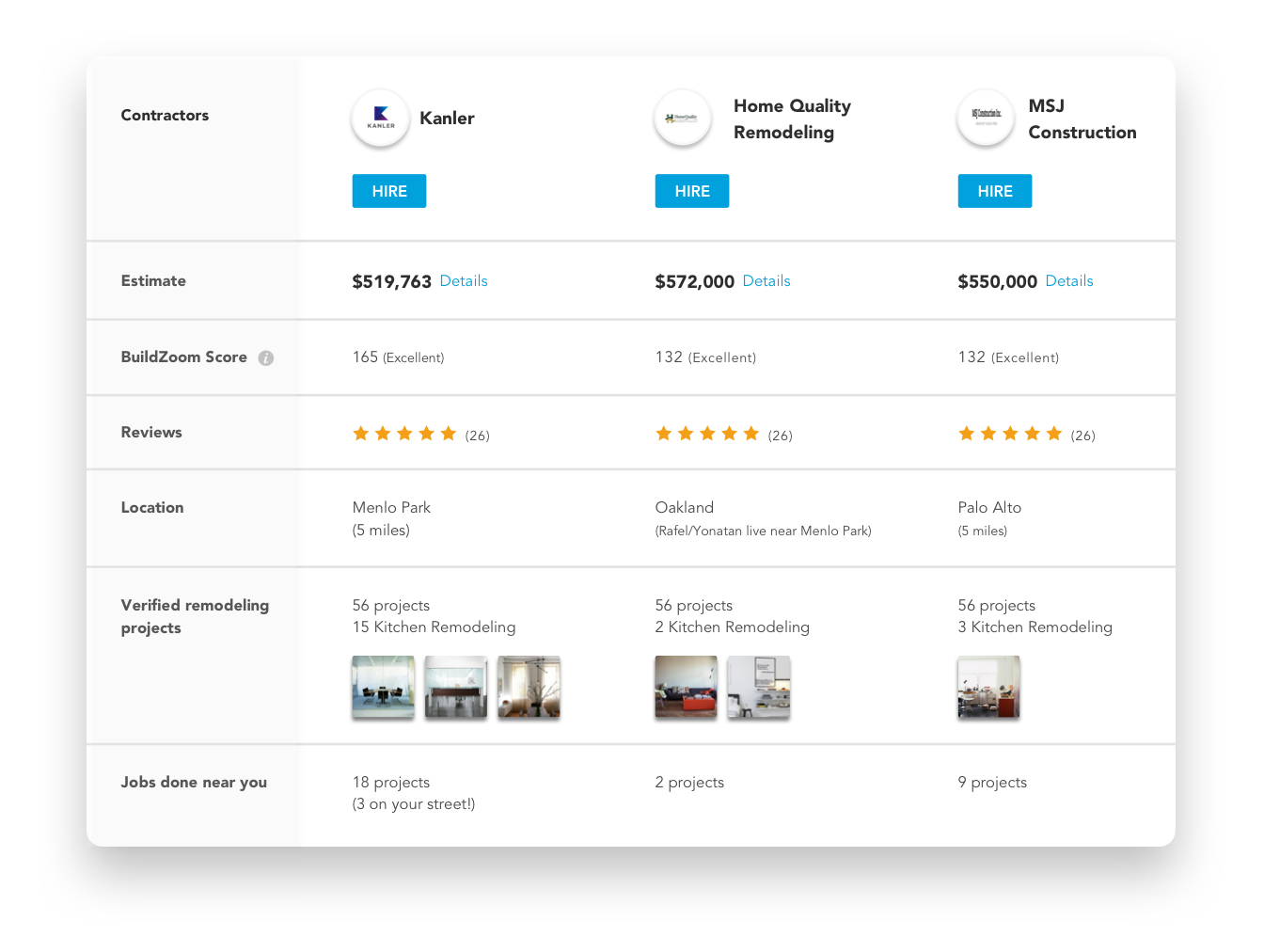
For many homeowners, properly evaluating proposals before signing a contract can be confusing and stressful. At BuildZoom, we offer a ‘bid leveling’ service that reorganizes the proposals into a matrix structure that is easily comparable and will help identify potential pitfalls, abnormalities, or outliers. Our consultants will help ensure the proposals are priced for the same scope of work, and can follow up with contractors on your behalf if additional details are needed.
[/twocol_one]
[twocol_one_last]
[/twocol_one_last]
Making a decision
[twocol_one]
The decision of who you will hire is ultimately one of personal preference. How you choose to prioritize cost, quality, and timeliness will help determine which contractor is the best fit for you.
If you prioritize your budget above all else, you may select a contractor that specializes in building more economical homes over the highest quality builder. Those who care primarily about timeliness may choose a more expensive bid that can allocate more manpower to get the job done quickly. If building a high-quality home is your top priority, you will likely need to compromise in the area of cost or timeliness.
[/twocol_one]
[twocol_one_last]
When determining who to hire, cost should not be the only consideration when evaluating proposals. Be thoughtful about what is important to you, and whether you can see yourself working closely with the contractor for months (or years!) to come.
[/twocol_one_last]
[/fivecol_four]
[fivecol_one_last]
[/fivecol_one_last]