In the coastal cities of California, the declining affordability of housing has been a source of universal exasperation for decades. Recently, new legislation was passed at the local and state levels aiming to encourage the construction of secondary units – also known as Accessory Dwelling Units (ADU) – as a way to grow the housing supply. A look at the initial impact shows that hundreds of new units are being planned for San Francisco, and fully utilizing backyards and other available spaces could mean thousands of future residences for California’s coastal cities.
Mitigating The Housing Crisis with ADUs
The increase in housing prices has been driven by the strong draw of California’s natural amenities and economy, coupled with decades of constrained home construction. Community advocates disagree on how to best mitigate the crisis, but a growing number of policymakers, economists, and urban planners are pointing to secondary units as low-hanging fruit in the struggle to create more housing.
Accessory Dwelling Units (ADU) are independent dwelling units added to a primary residence and can be built within the envelope of an existing building or as a detached structure in the rear of the lot. Also known as in-law units, backyard cottages, secondary units, basement apartments, or granny flats, these dwellings are equipped with their own kitchens, bathrooms, and entry ways. Compared to your average single-family home, they are relatively simple and cheaper to build.
Adding ADUs to existing single-dwelling lots are essentially a form of micro-infill, where underutilized spaces can be used for densification without compromising neighborhood character. Since ADUs are a fraction of the size of primary residences, they add to the stock of more affordably-priced housing, and help to minimize the displacement of lower and middle-income residents. The fact that ADUs aren’t exclusively serving the wealthy and won’t greatly transform the physical appearance of the city is important for finding common ground with activists who argue against new developments.
The potential for ADUs to address housing issues and create flexibility in living arrangements is not a novel concept for policymakers. The state of California sought to encourage the construction of ADUs back in 1982, when it passed the Mello Act which mandated that secondary units be permitted in all jurisdictions. Yet the means of implementation and the power to set parameters remained with local governments, where a confluence of restrictive land-use regulations, building codes, and lengthy permitting processes often precluded opportunities for building ADUs.
New Statewide Regulations
Recent amendments to the state Government Code effective January 1, 2017 take a bolder stance in lowering barriers to ADU construction and prevents local regulations that are “so arbitrary, excessive, or burdensome so as to unreasonably restrict the ability of homeowners to create second units.” Under the two major bills Senate Bill No. 1069 and Assembly Bill No. 2299, a secondary unit can no longer be charged connection fees and capacity fees equal to a primary residence, and impact fees for water, sewage, or traffic services must be proportional to its size.
Another big impediment to ADUs used to be the requirement to create off-street parking for the tenant. SB 1069 waives this requirement if the second unit is within an existing primary residence, if the home is within one-half mile of public transit, if the home is within a block of a car-share location, or if it is within an architecturally and historically significant area. The installation of fire sprinklers is also no longer necessary if they are not required in the primary residence.
The amendments also streamline the permit process by obliging local governments to ministerially approve any ADU in an existing residence regardless of zoning standards, as well as all ADUs that comply with given criteria such as parking requirements, maximum size, and setback regulations. Ministerial approval means the person who reviews the application will no longer exercise their own discretion in whether to approve the project in cases where all necessary criteria have been met.1
A third bill, Assembly Bill No. 2406 creates more flexibility for ancillary residences by authorizing a smaller version of the ADU, known as the Junior Accessory Dwelling Unit (JADU) which has a maximum size of 500 square feet and does not require its own bathroom facility.
Regulations in San Francisco
In parallel with the state-level amendments, many local jurisdictions have begun to implement laws that encourage ADUs.2 In San Francisco, three ordinances have expanded participation in the ADU program. Ordinance 30-15 (effective March 2015) first authorized the addition of dwelling units in the Castro district when a homeowner opts for a voluntary or mandatory seismic retrofit. Ordinance 162-16 (effective September 2016) created a city-wide ADU program, and Ordinance 95-17 (effective June 11, 2017) was implemented to align with the state law that came into effect on January 1, 2017.
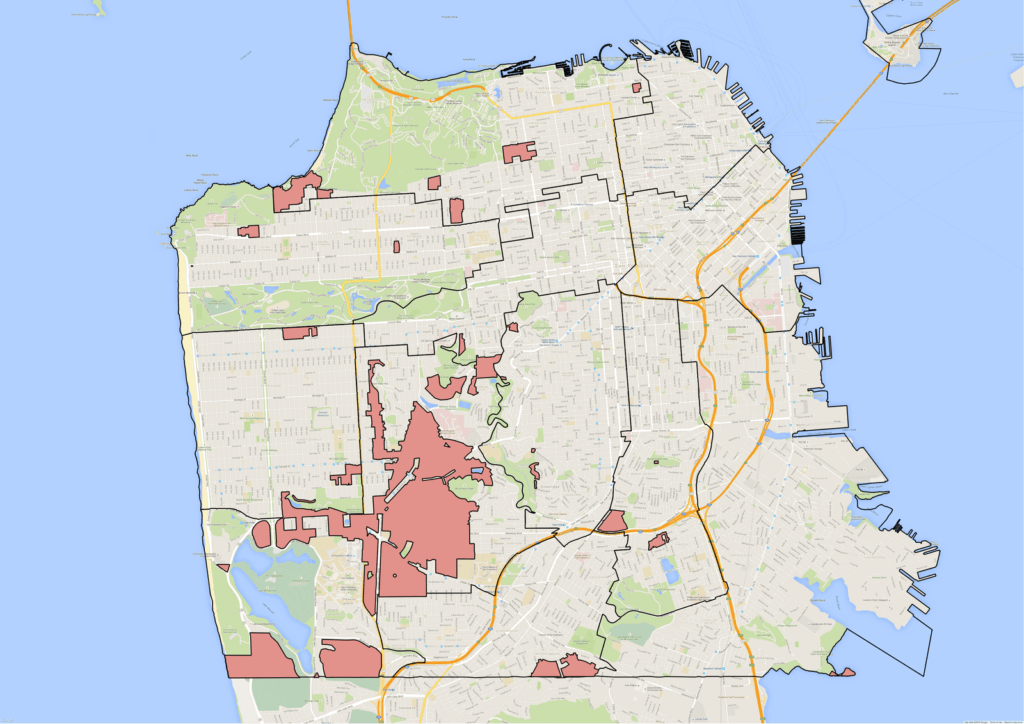
Under the new regulations, ADUs are permitted in all districts that allow residential use. One ADU is permitted for buildings with four or less units, while buildings with five or more units may build unlimited ADUs. As per Ordinance 95-17, it is no longer necessary to acquire a Zoning Administrator Waiver to install a unit in any RH-1 (D) zoned lot. (RH-1 (D) refers to a Single Family Dwelling lot with the lowest density zoning and requires side yards.)
ADU Requirements Reduced in RH1-(D) Zoned Districts
The Future of ADUs and the Housing Market
We already see the new amendments making an impact across the state in cities like Los Angeles, San Diego, and Santa Barbara, where ADU applications have tripled since May. For San Francisco, the Department of Building Inspection estimates that as of August 8 of this year, 380 permits have been submitted to add an accessory dwelling unit since the program was expanded, of which 8 have been completed.
Single-Family Zoned Lots That Could Potentially Build an ADU

It’s unlikely that ADUs will single-handedly solve the housing crisis, but one report in 2014 estimated that backyard cottages could add one-third more homes to San Francisco. If another residence is added to each of the city’s 124,000 single-family lots, it could increase the number of households by 33%.
Building Permits Recorded for New Accessory Dwelling Units in San Francisco
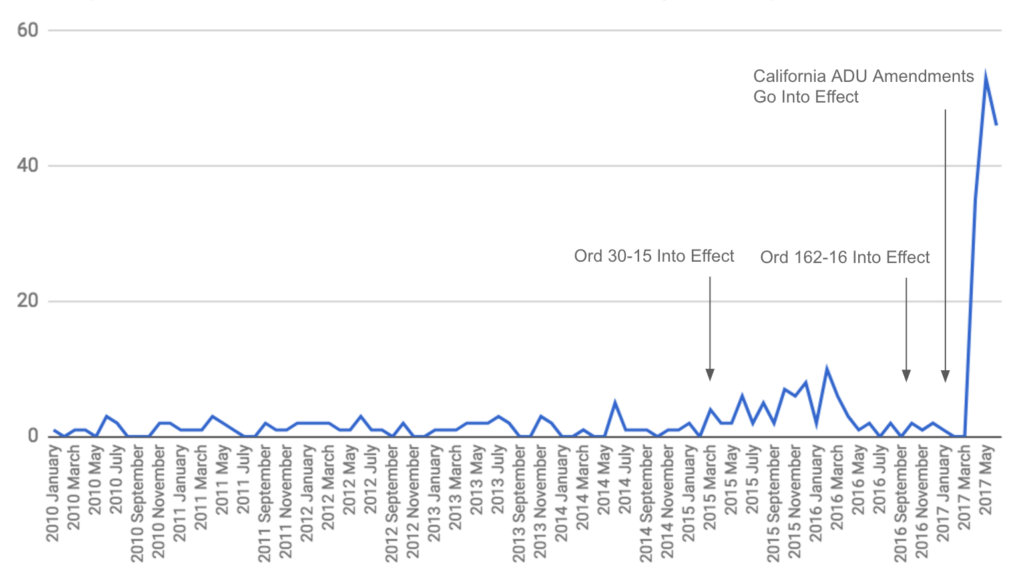
San Francisco’s building permit data can provide some insight as to whether the laws have been effective. Our data show a steady increase in building permits for new ADU construction since Ordinance 30-15 went into effect in March of 2015. Since the passing of Ordinance 162-16 and the Amendments to the California Code in September 2016 and January 2017 respectively, we’ve seen a sharp increase in the number of building permits filed for new ADUs.4
We will have to wait to see if this trend continues and what the total impact of San Francisco’s ordinances will be in generating new ADUs, but BuildZoom’s data suggest that the initial response is promising. In a city where there are limited options for building new affordable homes, this is an important first-step towards meaningfully increasing the supply of housing.
Resources
Accessory Dwelling Units Frequently Asked Questions
Summary of the Planning Codes Standards for Residential Districts
Accessory Dwelling Unit Memorandum
Building Additional Units on Your Property
Legalization of Dwelling Units Installed Without a Permit Ordinance No. 43-14
Addition of Dwelling Units per Ordinance 162-16
Frequently Asked Questions Ordinance No. 30-15
Footnotes
1. Strauss, Betsy. “Association of Bay Area Governments Planning for Second Units Forum.” 2003.
2. These local jurisdictions include the cities of Santa Cruz, Berkeley, Los Angeles, and San Luis Obispo.
3. This graph analyzes building permits from the San Francisco Building Department which contains the following terms: In-Law Unit, Backyard Cottage, Accessory Dwelling Unit, Second or Secondary Unit, Granny Unit, Granny Flat, Basement Apartment, and Ordinance 30-15, 95-17, or 162-16. All permits containing the above terms and pertaining to the new addition of an ADU have been included. Permits for ADU legalization or renovation work have been omitted.
4. It’s important to note that the number of construction projects tend to increase in the summer, and we should expect to see a natural cadence in the volume of projects over the seasons.

Super informative