On September 7, Jeff Bezos – the Founder and CEO of Amazon – announced plans to open a second headquarters, dubbed “HQ2,” claiming the company expects to invest $5 billion and create up to 50,000 high-paying jobs in a new location that will be “a full equal” to the Seattle HQ. The RFP from eligible cities triggered a wave of proposals from 238 applicants including states, provinces, districts, and territories across North America.
While bidders speculate that hosting HQ2 would be a boon to their economy, what would winning the competition really mean for the city? One way to imagine how the new headquarters will impact the cityscape is to see how Amazon grew in Seattle – where its original headquarters is located. Using BuildZoom’s National Building Permit Database, we tracked how Amazon’s footprint has grown over the last 10 years and calculated how many construction dollars HQ1 has infused into Seattle’s economy. Note that building permit valuations provide a lower-bound estimate on the amount actually spent on construction because they are cost estimates for the purposes of issuing permits before construction and don’t reflect later changes or additions. Design, engineering, and FF&E (furniture, fixtures and equipment) costs are also excluded. 1
Amazon’s first major Seattle headquarters was established in 1998 when it moved into 190,000 square feet of Beacon Hill’s Pacific Tower. In 2005, Amazon leased several floors of the Columbia Center in downtown Seattle, and by 2007, had made plans to relocate its headquarters to a collection of buildings known as the South Lake Union Campus (SLUC). By 2011, Amazon had vacated the Pacific Tower and Columbia Center. The move to the SLU Campus marked the beginning of Amazon’s explosive growth, and to date just two offices (Galaxy in Queen Anne and 425 Centre in Bellevue) are located outside of the South Lake Union and Downtown Seattle neighborhoods.
How big is HQ1 and how much went into construction?
Since Amazon’s big move to the South Lake Union area in 2007, over $1.9 billion in building permits have been filed for Amazon-occupied office space in the Seattle metro area, which spans nearly 13.6 million feet including future space.

The following maps show the location of all known Amazon offices in the Seattle metro area, and the total estimated improvement costs performed at each location based on building permit valuations. The years denote when the building or property was announced, and not necessarily when the lease was signed or when employees moved in.
The structures marked in orange, representing Amazon-owned buildings, account for a total of $1.8 billion in building permits to date. This number will grow as Amazon continues to develop three blocks in the Denny Triangle neighborhood (Block 20, 4th Block, and 5th Block).
The remaining $120 million was spent on tenant improvements for leased office spaces, marked in yellow. The blue buildings are future leases, and to date have not filed any building permits for tenant improvements specifically for Amazon or Amazon.com. Once the new office buildings are occupied, roughly half of its offices will be leased (54%), with the other half (46%) owned by Amazon.

The Cost of Amazon-Owned Offices
The South Lake Union Campus is a cluster of 10 buildings first developed by Vulcan Real Estate in 2007 and later sold to Amazon for $1.16 billion in 2012. The construction of the campus cost upwards of $450 million according to building permits.
Beginning in 2012, the development of three blocks (14, 20, and 21) in the Denny Triangle neighborhood, known collectively as Rufus 2.0, have pulled over $1.2 billion in building permits. Block 19 alone – which includes the iconic 36-story Day One tower and the much-anticipated glass biospheres – cost over $650 million according to permits. Block 14 has collectively pulled $277 million in building permits.
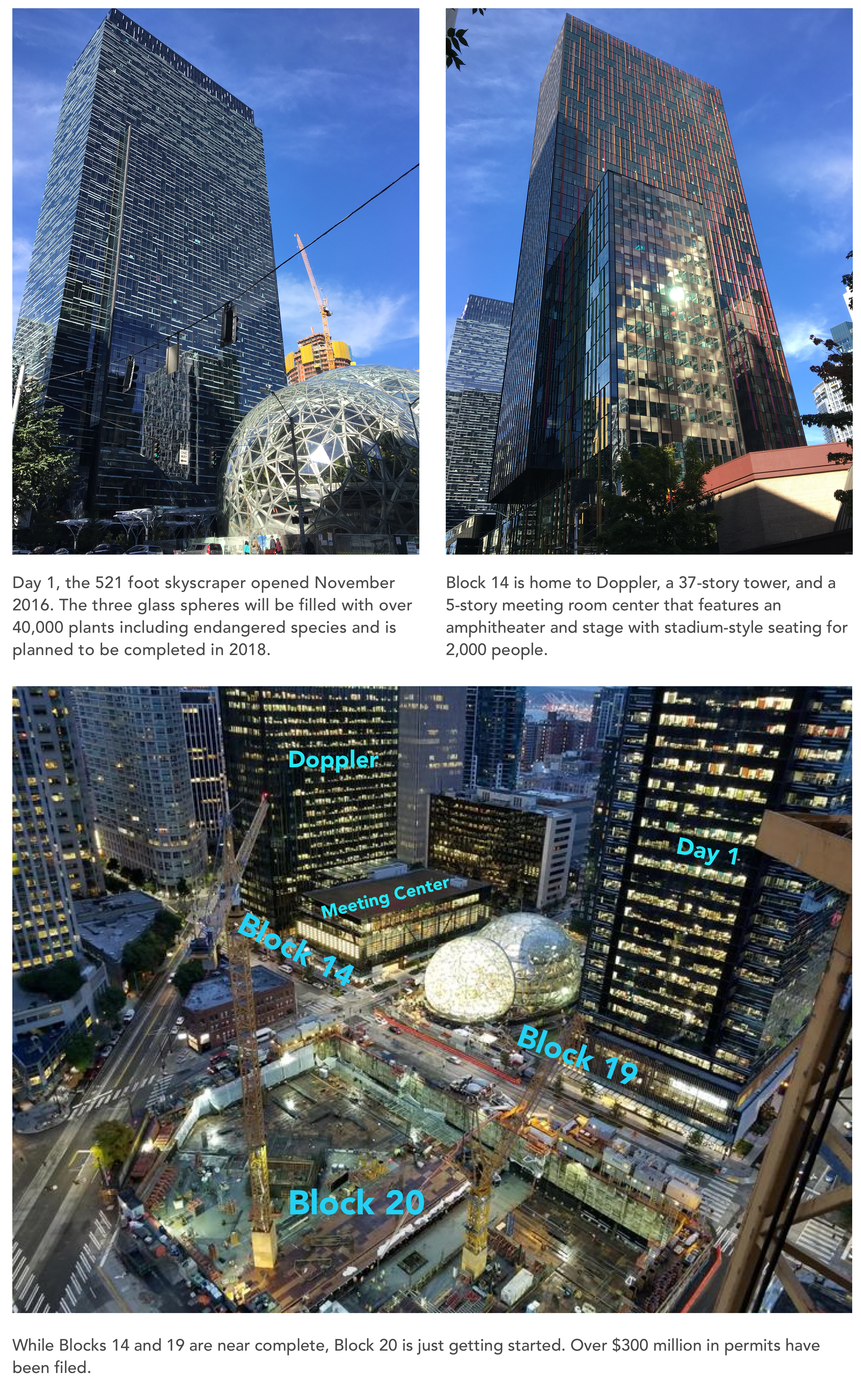
The 4th and 5th blocks are the most recent Amazon-owned parcels to be developed. The latest permit for 4th Block shows that shoring and excavation is moving forward for the 24-story and 8-story complexes. A 17-story building has been proposed for the half-block site of 5th Block, and a permit valued at $88 million was filed in July.
What HQ2 can expect, based on HQ1
Amazon’s total Seattle footprint has ballooned to 13.6 million square feet in 2017,2 eclipsing Amazon’s 2016 projection of 12 million square feet by 2022. The company’s explosive growth is most visible in the South Lake Union/Denny Triangle/Belltown area, where nearly 12 million of Amazon’s total 13.6 million square feet is concentrated.

Amazon’s total Seattle footprint could fill the Empire State Building 5 times over, or the Columbia Center – the tallest building in Seattle – more than 8 times.
“A campus of this magnitude will not be easy for any city to accommodate except for the very largest,” says BuildZoom’s Chief Economist, Dr. Issi Romem. “Amazon will likely build new office buildings, as it did in Seattle, but will likely also snap up significant square footage in existing office space, especially in its earlier stages of growth. Amazon will likely reduce vacancy rates, crowd out other tenants, and drive up office rents, especially in the short run. In the longer run, Amazon will expand the office supply and, more generally, help deepen the talent pool.” It is beyond the scope of this blog post to predict which cities will require the most construction on Amazon’s part or where the move will have a greater effect on office rents, but “as a rule of thumb,” says Romem, “the campus is likely to have a greater impact in a smaller metro area. Regardless of where cities’ office space markets are in the real estate cycle – it will likely take Amazon a whole cycle just to fully ‘move in’ – larger metros like New York or Los Angeles will have an easier time swallowing HQ2 than smaller ones like Denver or Atlanta. That being said, if Amazon’s offices are concentrated in a small area within a large metro, as is the case in Seattle, it can also have a disproportional effect on the real estate market around that neighborhood.”
Though we won’t know the winning city until next year, we do know that the chosen city is bound to look quite different 10 years from now. Perhaps the most interesting part of the speculation game – guessing exactly where and what HQ2 will look like – will have only just begun once the host city is named.
Notes
1. Building permit valuations are not the actual cost of construction. They are meant to supplement our understanding, not to tell the whole story.
2. Including future leases and buildings currently in development. Please note that two of the future leases, the former Pemco HQ and 9th & Thomas have been reported on but have not been confirmed by Amazon.
Methodology
In order to help tell the story of how much it cost to build Amazon’s HQ1, we added up the building permits filed at Amazon-owned buildings or Amazon-leased office spaces. For Amazon-owned properties, we added up all of the building permits filed at that parcel (including other addresses associated with that parcel) that pertain to Amazon within the relevant time period. For Amazon-leased properties, we have only included permits for tenant improvements that specifically mention Amazon.
The square footage for each building is taken from non-building permit sources, including but not limited to the building’s property website, past reports and articles, or commercial real estate websites which may have been rounded or estimated.

Well written and easy to understand—quite informative and very interesting!
It will be interesting to see just how much more Amazon grows as the years pass by. Some of their buildings are quite monumental.