This study was published jointly by BuildZoom and the Terner Center for Housing Innovation at UC Berkeley.

Key Takeaways
- The San Francisco Bay Area exchanges people of all income levels with all parts of the country, but the origins and destinations of those coming and going differ substantially by income.
- Low-income residents are over-represented among those moving between the Bay Area and more affordable parts of California, such as the Sacramento region and the Central Valley, while those moving between the Bay Area to farther destinations—primarily large metropolitan areas in other parts of the country—tend to have higher incomes, especially if the move is to or from the Northeast.
- Racial disparities in the region’s migration patterns are pronounced: Hispanics and Blacks make up a disproportionately large share of low-income out-movers, and are more likely than others to move to the more affordable parts of California. Blacks, in particular, are more likely to move to the Sacramento region, whereas Hispanics tend to move to other relatively affordable parts of the state.
- The emerging picture is one in which high-income individuals have access to a broad national menu of large cities—as well as the economic opportunity encapsulated in that menu—whereas low-income residents of California are relatively confined to the state’s economic margins. The income and racial patterns suggest that, without concerted action, the region risks backsliding on inclusion and diversity and displacing its economically vulnerable and minority residents to areas of more limited opportunity.
Introduction
[dropcap]E[/dropcap]ven as housing costs in the San Francisco Bay Area soar to new heights and prompt large numbers of residents to leave or contemplate leaving each year, the region’s population keeps on growing. Talk of the tech industry relocating elsewhere surfaces regularly, and yet Silicon Valley and the broader regional economy are as vital as ever and continue to maintain a powerful magnetic pull. The Bay Area can create enough jobs to support far more population growth than it actually incurs, but because local land use policy and high construction costs severely limit the amount of new housing built, affordability pressures continue to mount and the population grows much more slowly than it otherwise would. Indeed, almost one-third of the area’s recent population growth occurred in spite of modest construction, through an increase in the average number of residents per home.1
The primary concern with respect to people leaving is not that the Bay Area’s population will suddenly contract—that would be akin to worrying that the runoff from an overflowing bucket will cause it to empty. Rather, the concern involves the differences between those moving in and out, and what the exchange of people means for the region, as well as the nation. Those moving into the Bay Area are substantially more affluent and educated than those leaving, whereas the latter are disproportionately more likely to be Hispanic or Black. The discrepancy between the inbound and outbound movers captures the intensity with which the region’s social fabric is changing. In fact, among all large U.S. metros, the Bay Area has the greatest such discrepancy. The concern is that a greater outflow of people from the Bay Area means the nature of the region is changing more rapidly and profoundly than before.
Who moves in and who moves out matters. When in-movers differ substantially from the out-migrants they replace, it affects the socio-economic, racial, and ethnic composition of those living and working in the Bay Area, and influences the region’s level of inclusion, integration, and equity—or lack thereof. It also drives the increasing geographic separation of the haves and the have-nots across the country, influencing who has access to opportunity, and intensifying an ongoing national process of socio-economic polarization.
Below we further unpack the Bay Area’s recent in- and out-migration trends to understand where the incomers recently arrived from and where the outgoers headed, how the set of origins and destinations depended on people’s income, and how race and ethnicity intersected with these patterns. All in all, a picture emerges of the region becoming less inclusive of lower-income and Black households. It also suggests the financial constraints facing the state’s lowest-earning households are narrowing their geographic options and restricting their access to regions with greater economic opportunity.
The influx of affluent households to the Bay Area drove net migration gains overall, even as the region shed lower-income households.
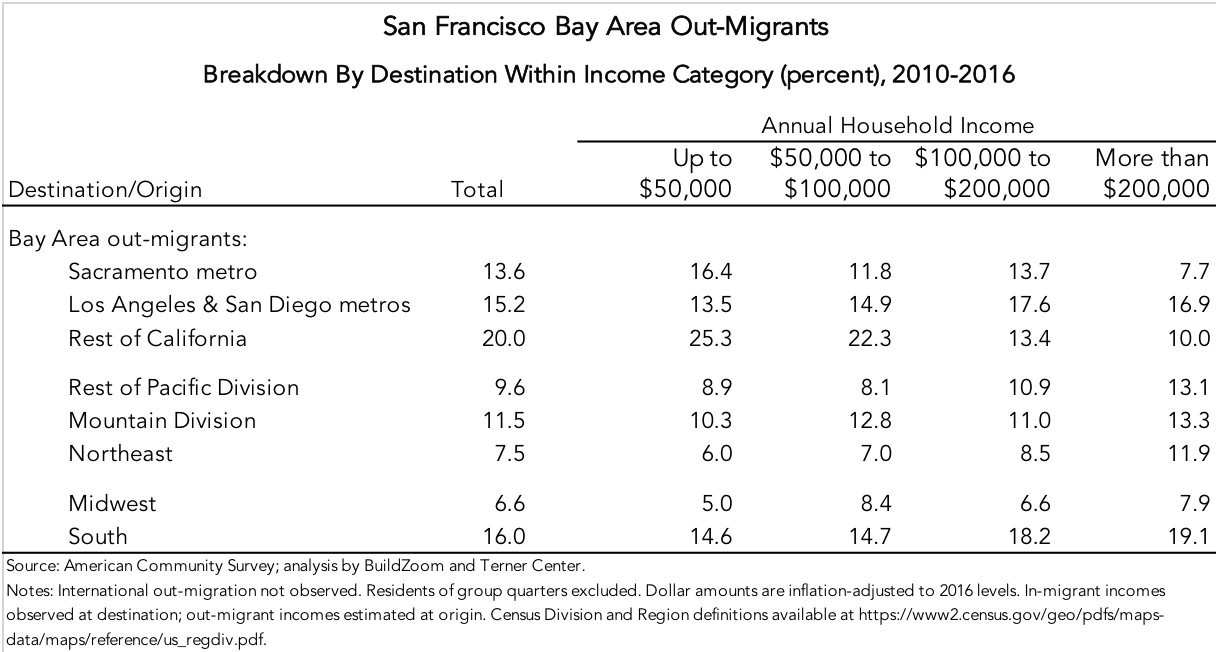
Almost 40 percent of the Bay Area’s domestic out-migrants were in households that earned less than $50,000 a year, and another quarter were in those making between $50,000 and $100,000 annually. That means for every one person in the top income category (with annual household incomes of $200,000 or more) who left the region between 2010 and 2016, six people under the $100,000 mark moved out.
At the same time, people across the income spectrum continued to move into the region—enough to keep the region with net migration increases overall—but, on average, in-movers’ incomes skewed higher than out-movers’. The share of in-movers making between $100,000 and $200,000 a year (per household) outstripped out-movers in that income range by 24.1 percent, while the proportion of in-migrants making more than $200,000 annually was 51.4 percent higher than the share of out-movers at that income level.

Lower-income households leaving the Bay Area did not relocate as far as movers with more means.
Where Bay Area out-movers ended up tended to depend on the level of resources they had. From 2010 to 2016, more than 55 percent of Bay Area out-migrants in households earning less than $50,000 a year stayed in California. The table below, which breaks down the destinations of those leaving the region by income, shows that the lowest-income out-movers were most likely to head to lower-cost, more affordable markets, such as the Sacramento region or Central Valley metro areas, like Modesto or Fresno.
But the opposite was true for households at the other, less resource-constrained end of the income spectrum. Most of the higher-income households that left the Bay Area left California altogether. Just one-third of those in households earning more than $200,000 a year stayed in the state, and those that did were most likely to move to other high-cost coastal regions like Los Angeles and San Diego. For those high-income households leaving California, many were drawn to other high-cost markets with vibrant economies, with New York, Seattle, Washington, D.C., and Denver leading the list. The South was also clearly a strong draw for high-income migrants. A number of major Texas metro areas, led by Dallas, Houston, and Austin, helped account for those high numbers, but other high-earners leaving the Bay Area traveled even farther to settle in the Raleigh, Atlanta, and Miami metro areas.
Download full breakdown of Bay Area out-migrant destinations and in-migrant origins
The origins and destinations of movers are mirror images, with higher-income movers more likely to relocate from, and to, farther afield.
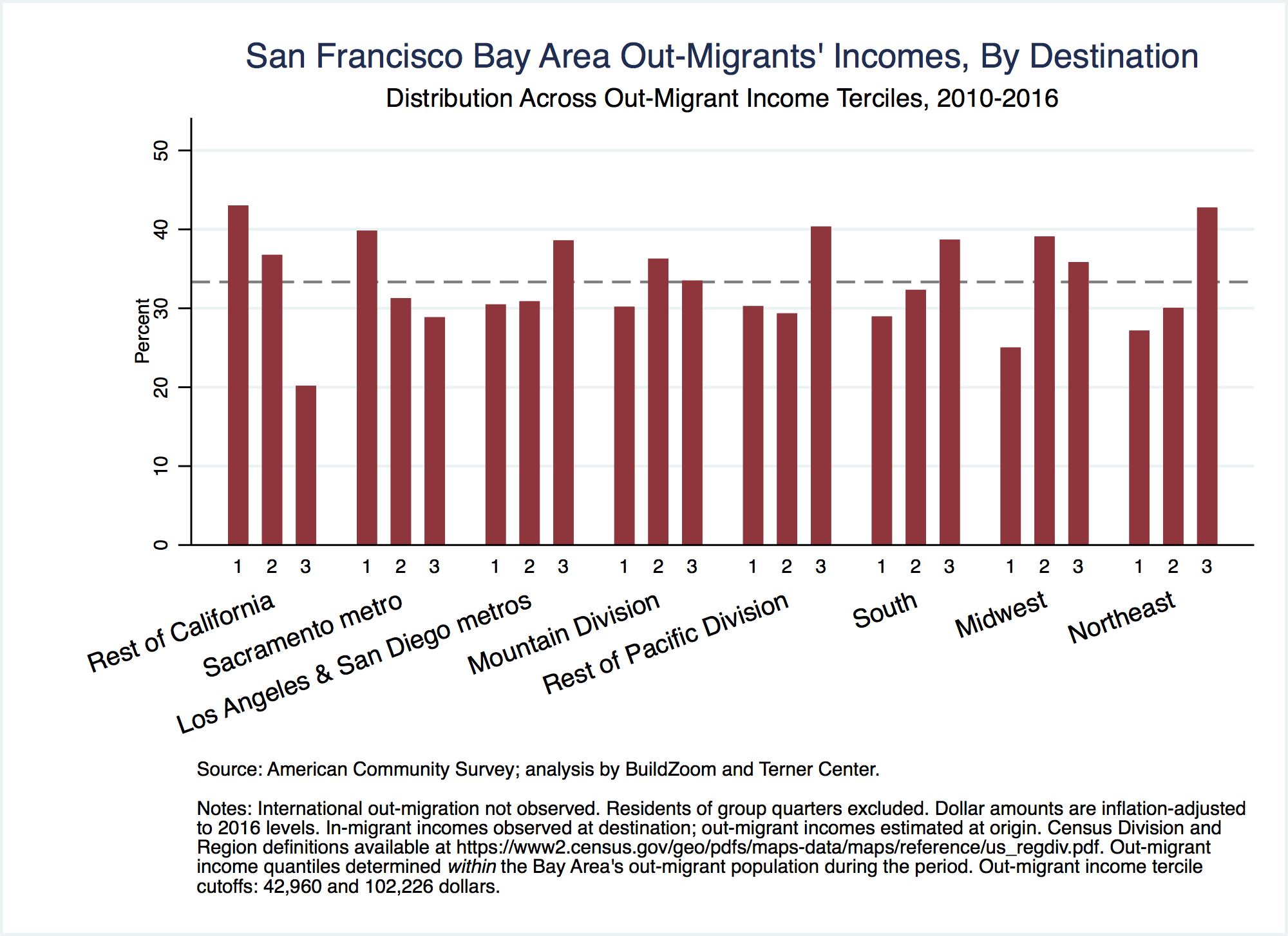
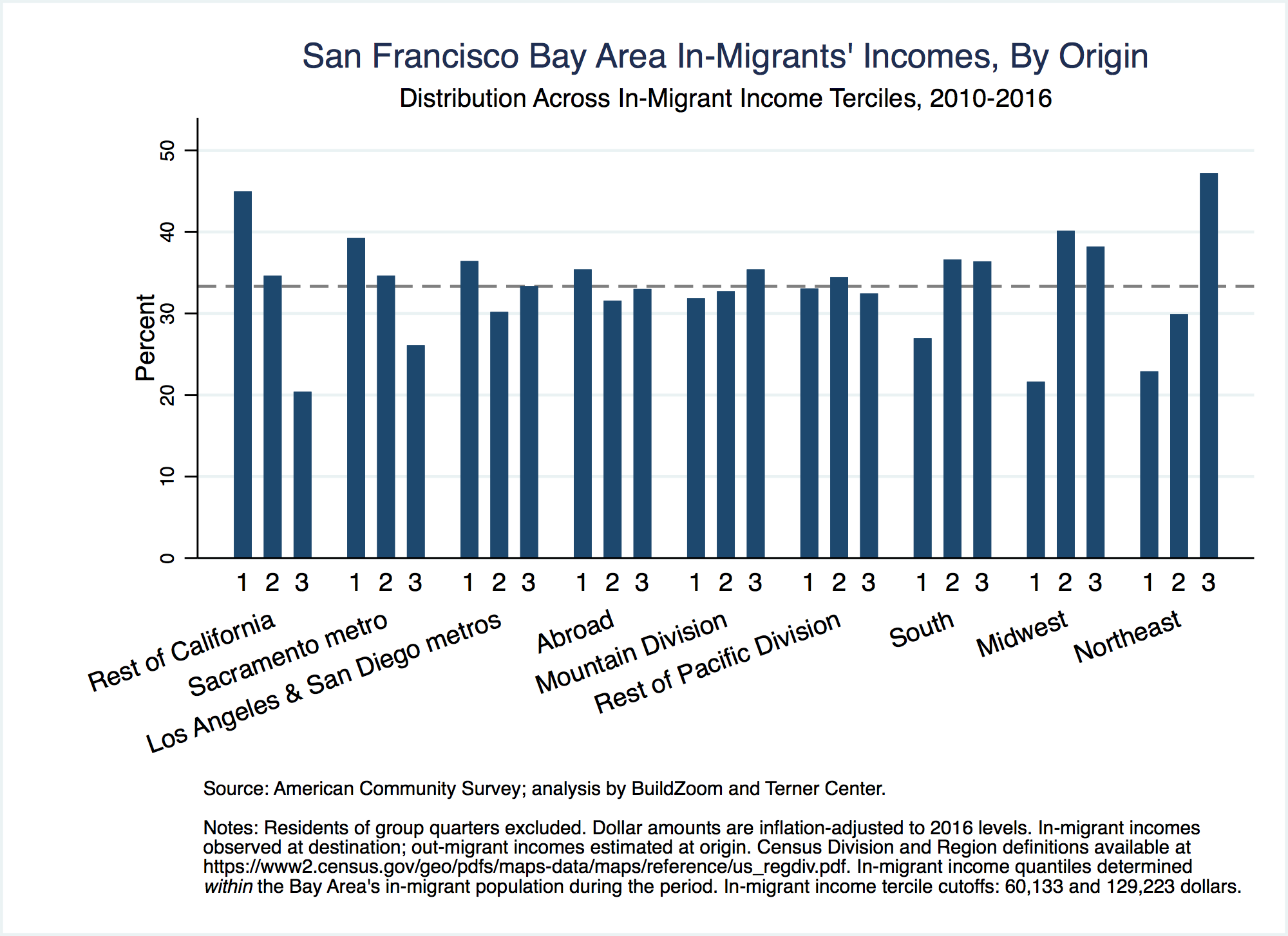
One way to visualize the relationship between movers’ income and their origins and destinations—including the constraints it imposes on the movers—is to classify them into lower, middle, and upper income bands such that an equal number of movers falls in each. This is useful because if people choose where to move independently of income then those targeting each individual destination should also split equally among the income bands, one-third each. Deviations from this equal-thirds distribution allow us to easily spot which income bands were under- or over-represented among those moving to each destination or from each origin.
And, indeed, the top panel of the figure below reinforces the earlier finding: that out-movers with lower incomes did not range as far from the Bay Area as those with more resources. The lower panel illustrates that similar geographic dynamics—or constraints—emerge for those moving into the Bay Area. Low-income movers, for example, are over-represented among those coming into the Bay Area from the more affordable parts of California: 45.0 percent of those arriving from the “rest of California”—anywhere in the state except for the Los Angeles, San Diego, and Sacramento regions—belonged to the lower-income category. This level is well above the dashed gray line which demarcates equal thirds. On the other hand, just 20.4 percent of these movers belonged to the higher-income category.2 The contrast with those moving from the Northeast is stark: 47.2 of those moving to the Bay Area from the Northeast belonged to the higher-income category, compared to just 22.9 percent of the lower-income category.
Low-income out-migrants were disproportionately likely to be Hispanic or black.
Racial and ethnic disparities in the region’s migration patterns are pronounced: Blacks and Hispanics made up a disproportionately large share of lower-income out-movers. Once again using three income bands such that an equal number of out-movers falls in each, the chart below visualizes the over-representation of lower-income movers among Black and Hispanic out-migrants. The tendency of out-movers to be lower-income was a shade more pronounced for Blacks than for Hispanics, but is striking for both. Asian and White out-movers, on the other hand, skewed modestly towards higher-income.

Just as Black and Hispanic households were disproportionately represented among low-income households, they were also more likely than others to relocate to more affordable parts of California: 49.6 percent of Hispanic out-movers and 36.4 percent of Black out-movers went elsewhere in California (excluding the higher-cost Los Angeles and San Diego regions). The corresponding figure for other Bay Area out-movers was only 29.1 percent.
Blacks and Hispanics leaving the Bay Area for more affordable parts of California differed in their typical choice of destination. Among Black out-movers, 56.5 percent of those headed to the more affordable parts of California moved to the Sacramento region, compared to just 27.1 of Hispanics, who were more likely to end up in destinations in the Central Valley. Black and Hispanic out-movers’ destination over this period aligned with existing concentrations of Black and Hispanic populations in the state. The share of Black residents in the Sacramento region is about 60 percent higher than it is in other more affordable parts of the state, whereas the Hispanic share of the population in these parts is more than double the Hispanic share in Sacramento.
Clearly, who moves out of the Bay Area and where they go is not just about income, it’s also about race.
The emerging picture
In broad brushstrokes, the pattern that emerges from this analysis is one in which high-income out-movers are mobile across a much broader geography than their low-income counterparts. While high-income out-movers come and go between large metropolitan areas throughout the nation, low-income out-movers correspond to an outsized share of those moving between the Bay Area and the more affordable parts of California.
As with any set of stylized facts, documenting them is a crucial first step. Although offering a definitive explanation is beyond the scope of this study, we can offer some thoughts. At the most basic level, the cost of moving grows with distance, and high-income households can better afford to move farther. It strikes us as more important, though, that the socio-economic and professional circumstances that coincide with earning a high income may enable people to move between the nation’s largest metro areas—both in search of opportunity and in response to it—more often than the circumstances surrounding lower incomes. Leading universities as well as well-paying professional and corporate career opportunities tend to concentrate in the nation’s large cities, and people in specialized, higher-paying types of work are more likely than others to find their next opportunity in a different city than the one they live in.
When lower-income residents leave the Bay Area, that largely means moving to parts of California that are more affordable, as we have shown. These movers tend to remain within proximity of where they previously lived—typically within a few hours’ drive. Such moves are likely to reflect economic necessity more often than voluntary will, as movers seek affordable housing further and further from California’s coastal economic nexus, while trying to maintain proximity to family, friends, and their broader social circle. Low-income households are more likely than others to rely on the latter for their basic needs, such as help with child-rearing, finding a job, or maintaining clientele for a small business. When such dependencies are irreplaceable, the prospect of a long-distance move becomes far less compelling, not to mention less feasible.
Conclusion
Whatever the reasons for the difference in high- and low-income mobility patterns vis-à-vis the Bay Area, some important implications are clear. Although high-earners may be displeased by the tradeoffs imposed on them by rising Bay Area housing costs, they ultimately have a rich set of options in other parts of the country. In contrast, as they get priced out, low-income Bay Area residents are increasingly confined to the more affordable parts of California, which are also the state’s less opportunity-rich economies.3 This type of confinement vastly diminishes their access to employment and education options, marginalizing them economically.
That a disproportionate share of economically marginalized low-income movers are Hispanic and Black residents belies the values of inclusion, integration, and equity so often championed by leaders in the Bay Area.
Making meaningful progress to reverse these trends will require multiple, coordinated strategies that together can enable a broader set of people to share in the Bay Area’s prosperity. Accommodating growth in the most literal sense, through more housing—and at all levels of affordability—is one of the solutions that could help ensure more people—at all income levels—are able to stay.
New housing will provide better access to opportunity, especially to low-income people of color, if it is built within the Bay Area’s developed footprint through densification, in ways that help foster diversity within schools and neighborhoods. For this to happen, communities across the Bay Area must do their share and accommodate new development, not only in pockets of density—whose appeal to families with children is limited and which could potentially devolve into concentrations of have-nots—but also through the gradual upzoning of areas currently reserved for single-family homes or otherwise encoded to ward off growth.
If residents, planners, and policymakers in every part of the Bay Area embrace their fair share of new housing, density, and growth, the impact on the physical environment and infrastructure will be shared more broadly, making these changes more palatable for everyone. Embracing growth in ways that mitigate displacement pressures on low-income residents and communities of color would allow the ideals of inclusion, integration, and equity to be more readily and effectively achieved throughout the Bay Area.
Notes:
1 Between 2013 and 2016, the number of residents per home in the San Jose-San Francisco-Oakland, CA combined statistical area (CSA) increased from 2.67 to 2.70. Of the 282,000 net new residents over the period, the rising number of residents per home in the region’s 3.17 million homes circa 2013 accounts for approximately 93,000 new residents, i.e. 32.9 percent or almost one-third of the population growth.
2 Note that the Stockton-Lodi, CA metro area is included in the San Jose-San Francisco-Oakland CSA, which means these numbers obscure similar “moves to affordability” that likely took place within the larger region. A wealth of information on internal Bay Area migration patterns by race and income is available from U.C. Berkeley’s Urban Displacement Project, including a recent analysis they conducted with the California Housing Partnership on Rising Housing Costs and Resegregation: http://www.urbandisplacement.org/research.
3 Some of the more affordable parts of California are simply the new, exceedingly remote frontier of the Bay Area’s commute shed. They are sufficiently distant from the core to be affordable at lower income levels, but they require increasingly large numbers of people—predominantly of low income—to take on absurd daily commutes or resort to commuting on a weekly basis, both of which take a terrible toll on personal and family well-being.
Methodology:
This study uses data from the American Community Survey, and in particular from the 1-year individual and household data from the years 2011 through 2016. For details regarding (i) the definition of metropolitan areas, (ii) the identification of migration, its timing and its origin and destination, and (iii) the determination of income levels at origin and destination, see methodology notes in the related study entitled “Characteristics of Domestic Cross-Metropolitan Migrants”.

Leave a Reply