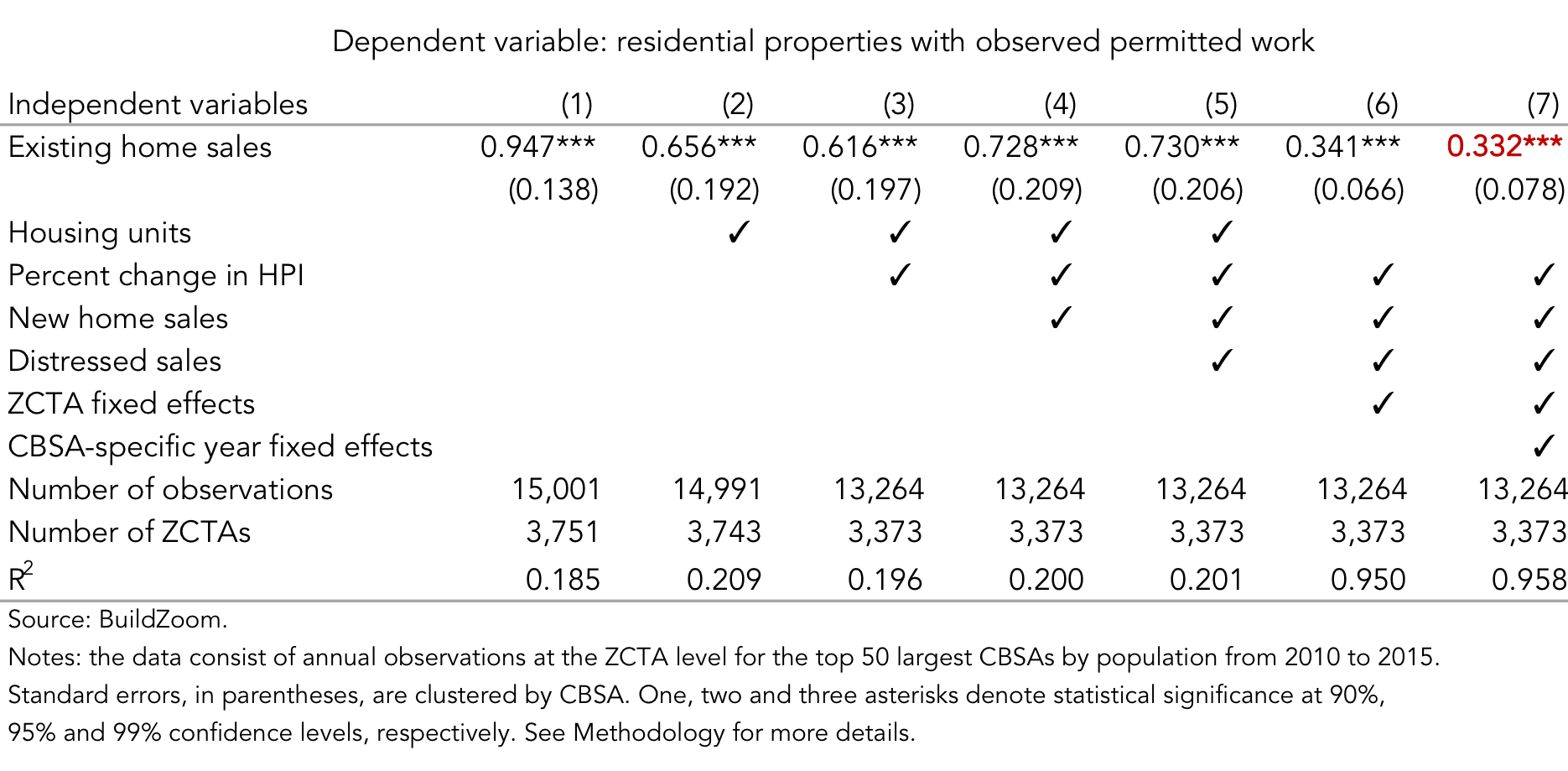
- On average from 2010 to 2015, every 3 existing home sales generated construction activity in 1 additional home.
- Even though people routinely care for their homes, the turnover of homes between owners is vital in keeping the housing stock up to date.
- The up-front cost of deferred maintenance and renovation when buying a home is likely to be greater, and affect first-time buyers more, after periods of low existing home sales.
Existing home sales often generate construction activity. When sellers address deferred maintenance and renovation before putting homes on the market, or when buyers do so after purchasing a home, the result is a burst of construction activity that wouldn’t have happened otherwise (or would have been delayed, often indefinitely).
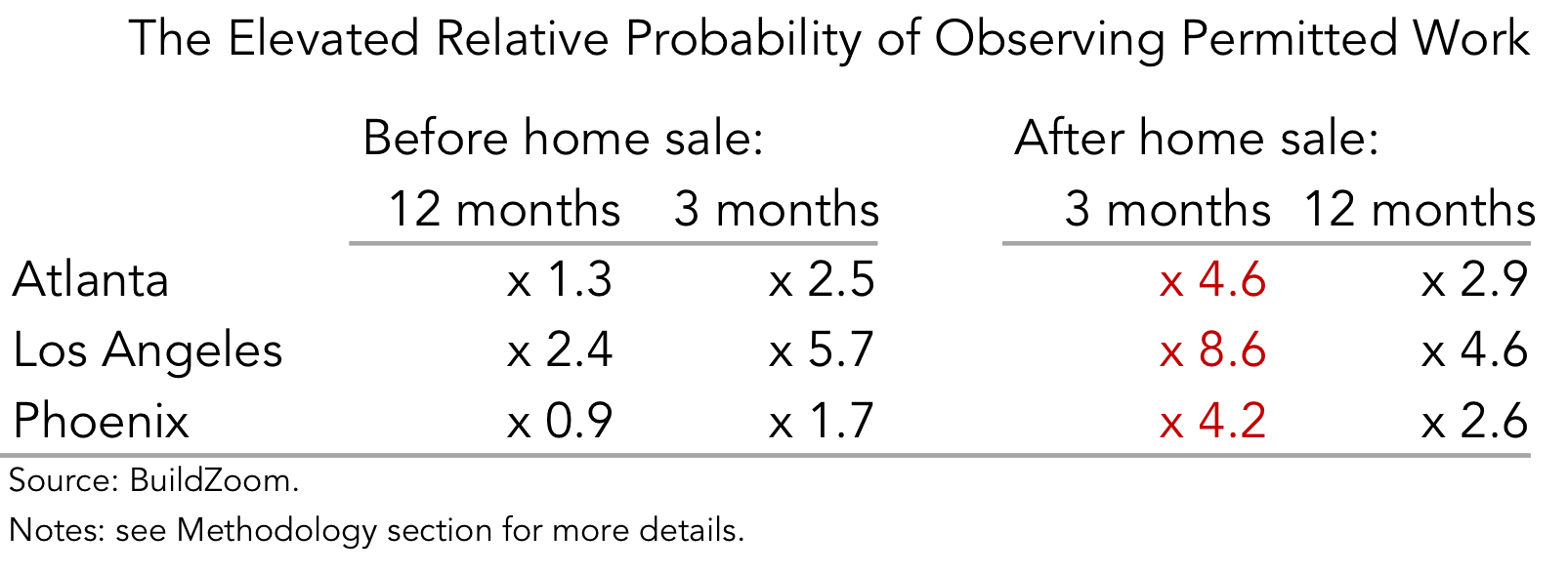
Data on building permits and home sales – the latter courtesy of Trulia – suggest that home sales’ role in driving remodeling and maintenance is substantial. In the City of Atlanta, for example, the probability of observing permitted work on a home from 2010 to 2014 was almost 3 times higher than normal during the year after a home was bought, and was more than 4.5 times higher than normal during the first three months (see Methodology below for details). The probability was also elevated just before homes were sold, but not nearly as much as after the sale.
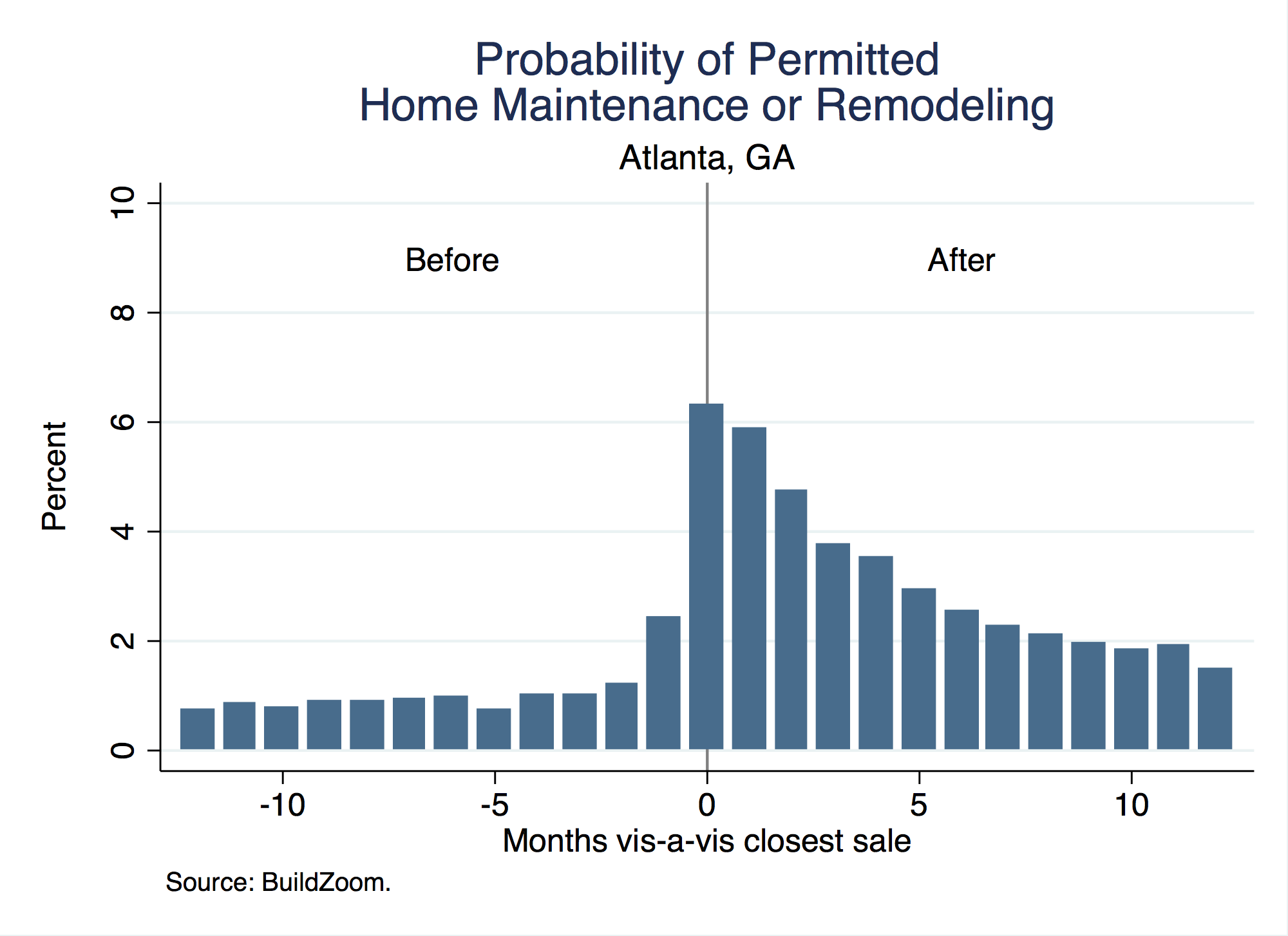

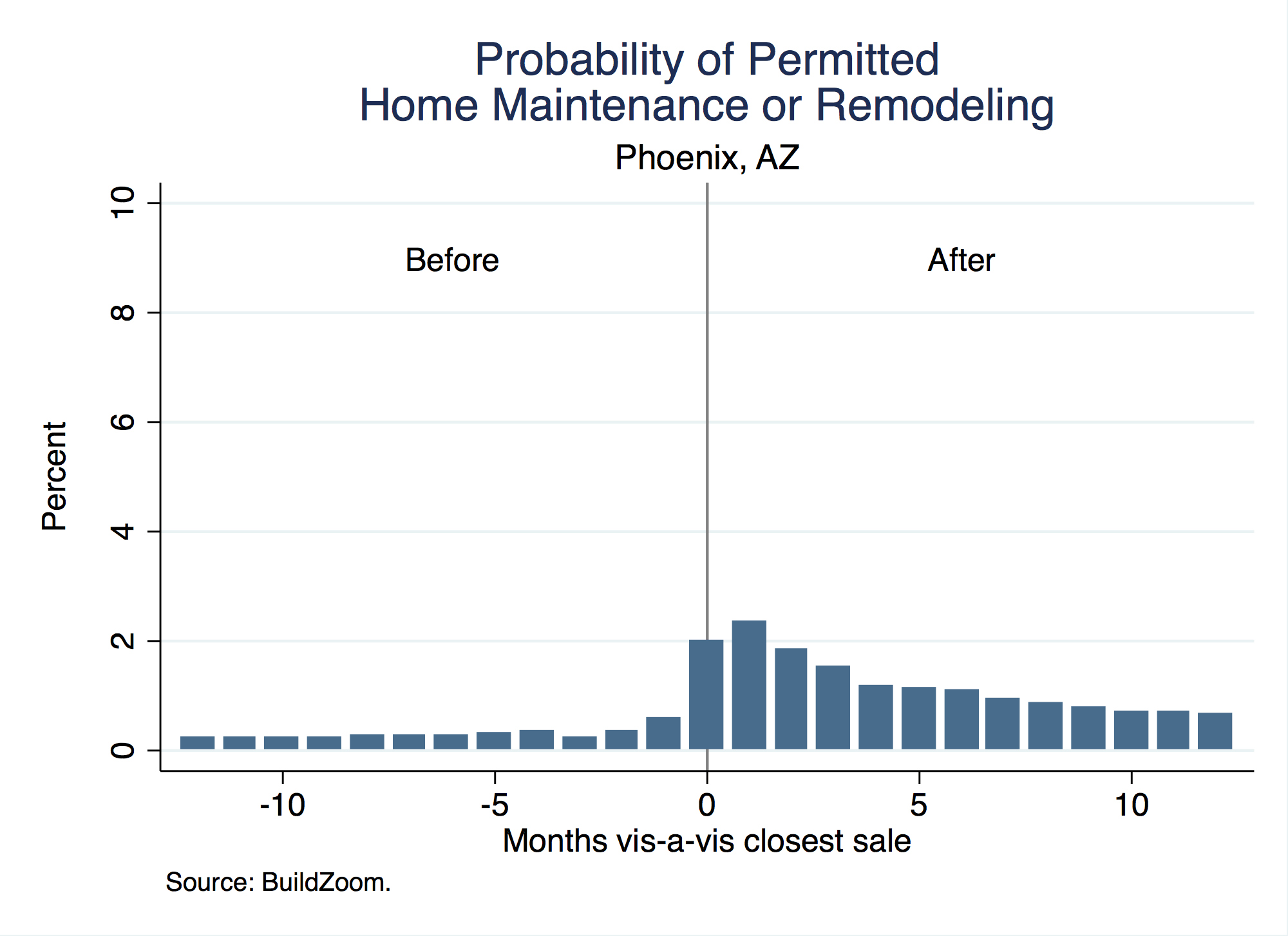
A similar pattern emerged in all other cities in our analysis, including Los Angeles and Phoenix, shown alongside Atlanta. The overall probability of remodeling and maintenance in existing homes in Atlanta is between that of Phoenix and Los Angeles because the housing stock in Atlanta tends to be older than in Phoenix and newer than in Los Angeles.
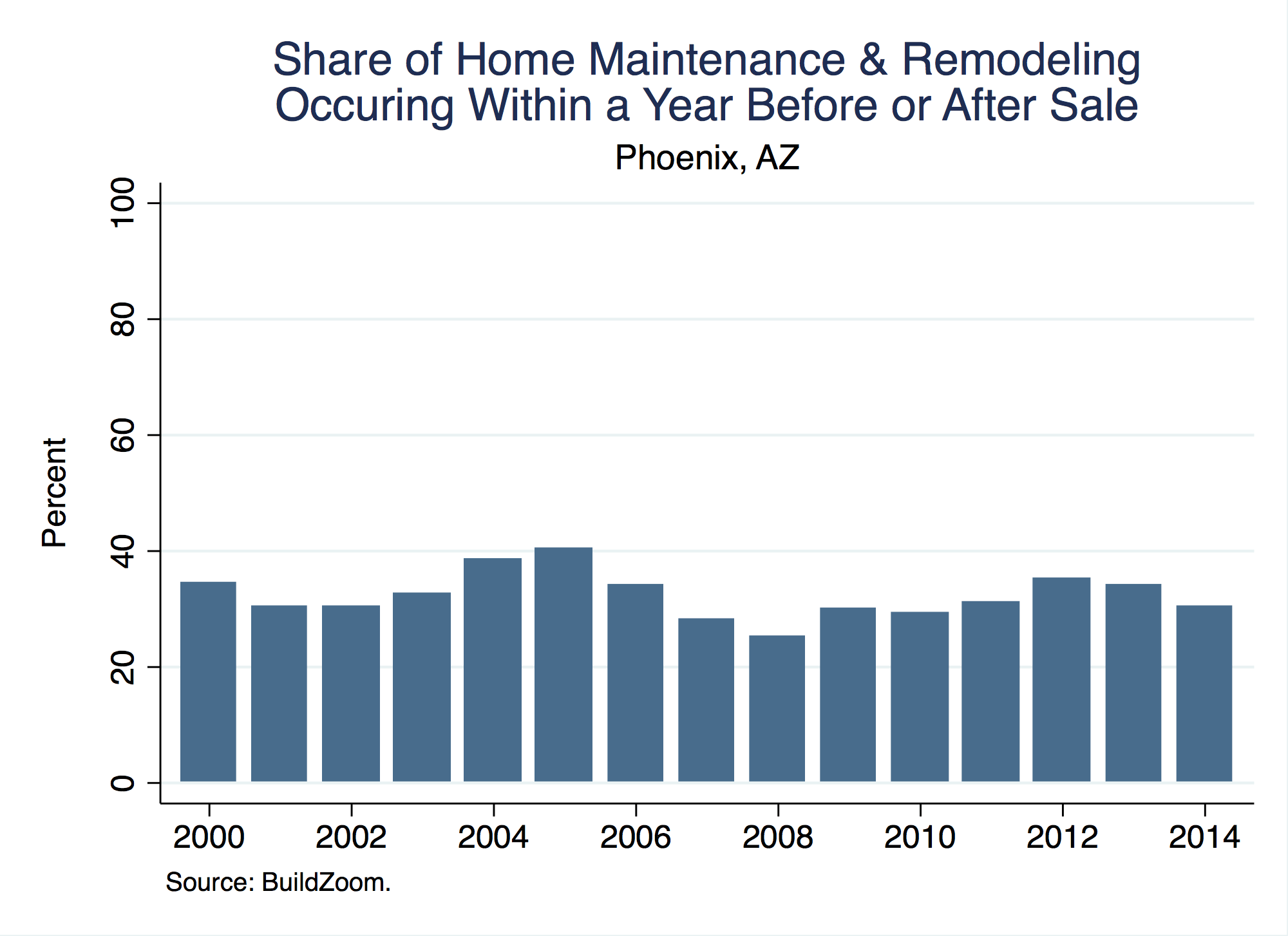
The share of permitted work occurring within a year before or after a sale has fluctuated over time, but only to a limited extent. In Phoenix, for example, the share ranged from a high of 40.3% in 2005, during the housing boom, to a low of 25.3% in 2008. The share exhibited a pro-cyclical pattern in all of the observed cities, i.e. it rose during the housing boom, decreased during the bust and has been slowly rising since. However, as the chart shows, the extent of fluctuation over time has been limited, and it is a reasonable approximation to say that typically about a third of remodeling and maintenance occurs within a year before or after a sale. The other cities exhibited a similar pattern over time.
At the national level, residential remodeling and maintenance are positively correlated with existing home sales. The next chart plots the number of existing home sales against the BuildZoom & Urban Economics Lab Index, which tracks residential remodeling and maintenance activity. Of course, the correlation on its own does not imply causation. For instance, if people’s prospects were brighter before the Great Recession and, as a result, they were more willing and able to take on debt, this could have led to the higher levels that we see of both home sales and remodeling, even if the former wasn’t actually driving the latter. However, juxtaposing the chart with the earlier evidence regarding the timing of remodeling and maintenance vis-a-vis sales leaves little room for doubt that home sales were, in fact, responsible for generating some amount of construction activity.
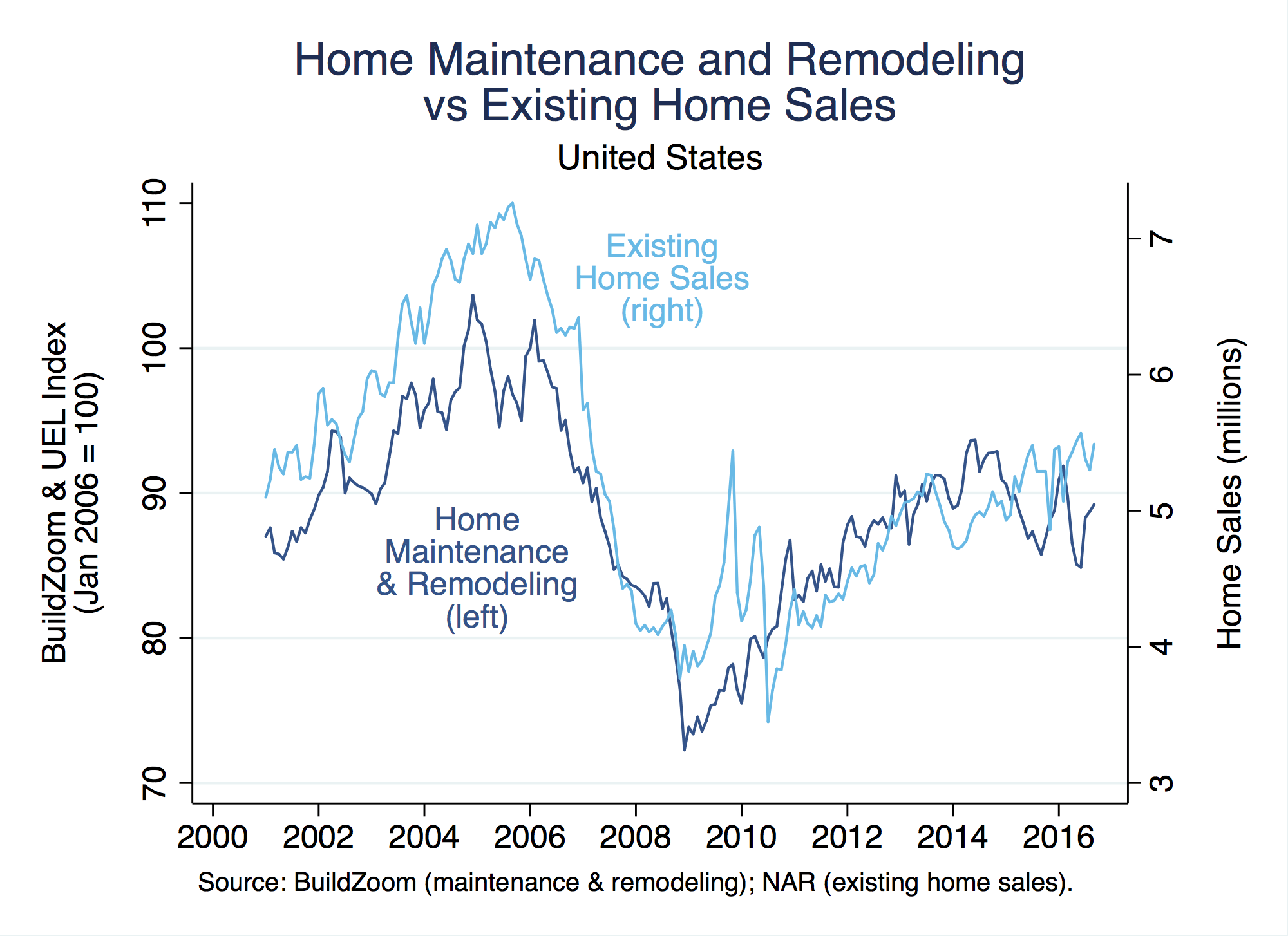
The remaining question is how much permitted work do existing home sales generate? The earlier analysis of timing vis-a-vis home sales suggests that, on average, every additional existing home sale generated permitted work on approximately 0.25 existing homes in Atlanta, 0.32 homes in Los Angeles and 0.09 homes in Phoenix (see Methodology below for details).
Similar results emerge from a separate analysis of data on building permits and home sales at the zip code level in the top 50 US metro areas – the latter type of data courtesy of CoreLogic. Using econometric techniques to crudely disentangle correlation from causation we estimate that nationally, from 2010 to 2015, every additional existing home sale generated permitted work on approximately 0.33 existing homes on average, i.e. every 3 existing home sales generated construction activity in one additional home (See Regression Appendix below for details). This estimate is higher than the city-specific ones coming from the analysis of timing vis-a-vis home sales, but it is in the same ballpark.
Implications
Overall, the evidence suggests the share of home maintenance and remodeling driven by existing home sales is substantial, but what are the implications? These activities prevent the existing housing stock from deteriorating and keep it functionally and stylistically up to date. If one thinks of them as capturing the pace at which the housing stock is maintained and updated, it becomes clear that when the volume of existing home sales is low, the upkeep of the existing housing stock suffers, and vice versa.
Another implication is that the up-front cost of buying a new home – which implicitly includes the costs of deferred maintenance and renovation – is higher after prolonged periods of below-normal transaction volume. This applies in the present and is unfortunate given the generational nature of the current housing affordability crisis because it is bound to affect first-time buyers more than repeat buyers. Whereas repeat buyers can apply equity accrued in their old home to up-front costs like a down payment or deferred maintenance and renovation, first-timers cannot.
A recent NAHB update showed that over the past decade or so the US housing stock has aged more quickly than usual and, as I have explained before, this largely reflects the statistical effect of the dearth of new construction. However, if the upkeep of the housing stock suffers when existing home sales are low then the housing stock is not just aging faster in a statistical sense, it is also physically growing more shabby.

Thank you for sharing this wonderful article. It’s really informative and helpful.