This blog post originally appeared on The Outbox.
According to the National Association of Home Builders (NAHB), the median age of owner-occupied housing rose from 31 in 2005 to 37 in 2015. To get a sense of what the means, consider that if no new homes were built during that 10 year period (or demolished, converted, etc’), the median age would rise by exactly 10 years. A 7 year increase in the median age over a 10 year period isn’t that far from the no-change benchmark. The rate of aging is very quick.
Why is this happening? The main reason is the sluggish recovery of housing construction since the last decade’s housing bust. Normally, by which I mean roughly the 30 years prior to the bust, there were around 1.5 to 2 million new housing starts each year. Now, almost a decade after the housing bust, we’ve finally surpassed a rate of 1 million per year. In other words, the aging of the housing stock largely reflects the paucity of new construction since the bust.

In the background, even if it weren’t for the housing bust and its aftermath, the US housing stock would still be aging, albeit more slowly. That’s because every decade since the 1950s the US has added a roughly similar amount of new housing units per decade. Because the total number of homes in the country has grown over time, the roughly constant rate of addition represents a smaller and smaller increase each decade in percentage terms. As a result, the ability of new home construction to pull down the age of the housing stock has diminished over time, i.e. the housing stock has been slowly aging in the background for decades.
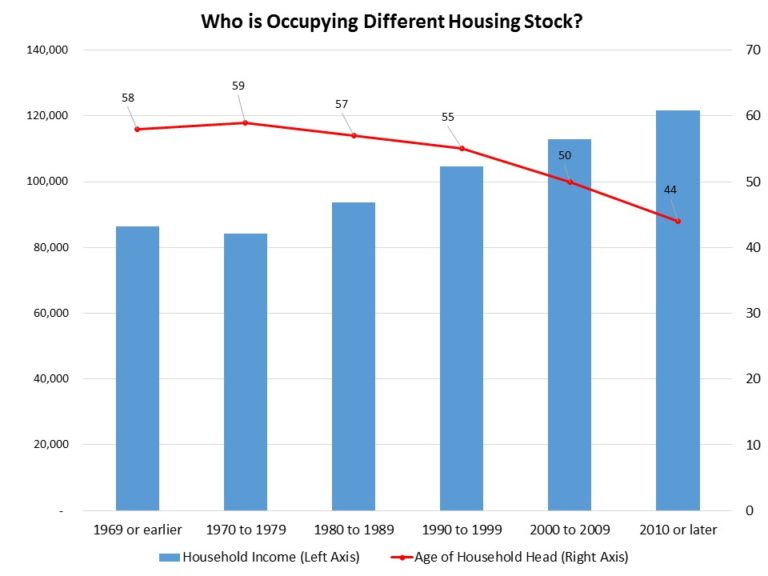
Another interesting tidbit from the NAHB post is that older homes are typically occupied by older people. Intuitively, that shouldn’t surprise anyone. However, bear in mind that older homes are disproportionately concentrated towards the metropolitan core, and that they are also disproportionately concentrated in more expensive metro areas whose outward expansion has slowed down. In this context, the fact that older homes are typically occupied by older people raises questions about the generational aspects of the current housing affordability crisis. More on this in the future.

Leave a Reply