By Issi Romem, BuildZoom Chief Economist
*** Note (October 6, 2015): an earlier version of this blog post reported figures obtained by comparing search results on Zillow.com and on Realtor.com within the core cities of the 51 largest metros. However, because the geographic boundaries associated with each city differ on the two websites, sometimes substantially, we have revised the post to report corresponding figures using the core counties of the 51 largest metros. The geographic boundaries of counties are virtually identical across the two websites.
Almost every home buyer begins searching for his or her dream home online. Today, that largely means looking for listings on Zillow Group portals, Zillow and Trulia, or on Realtor.com.
But which one is the best place to begin that search?
Depending on where you happen to reside — and especially if you intend to relocate — the portal you choose to search may be more important than you realize.
The crucial point for homebuyers, realtors and investors to take away is that the number of listings being provided still varies widely from city to city.
How The Listing Gap Evolved
According to comScore, Zillow and Trulia combined attract far more web traffic than Realtor.com.
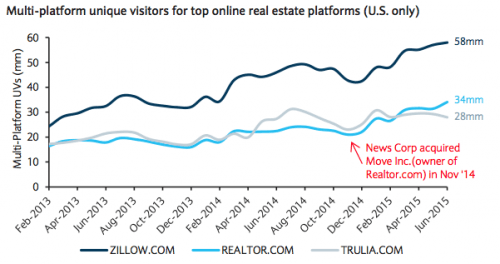
Source: comScore, Barclays Research via Housingwire.com
However, since News Corp. acquired Realtor.com the number of unique visitors to that site has steadily grown, and notably has now surpassed Trulia to become the second most popular portal.
But Realtor.com has a different advantage. Before its recent acquisition by News Corp., Realtor.com operator Move, Inc. had a 10-year head start, backed by the National Association of Realtors (NAR). This advantage has translated into the Realtor.com site having more timely, accurate and comprehensive nationwide listings. This is a result of receiving and updating data from almost all of the 800+ multiple listing services (MLSs) in the U.S. every 15 minutes.
The discrepancy between the number and quality of listings available on the Zillow Group portals and on Realtor.com attracted a great deal of attention in April, when ListHub — a key aggregator of MLS data, now controlled by News Corp. — terminated the contract, and stopped providing listing information to Zillow Group.
In anticipation of the event, Zillow Group scrambled to negotiate its own agreements with individual MLSs to obtain listings which it had previously obtained from ListHub. By mid 2015 Zillow Group had signed agreements with just over 300 MLSs.
At BuildZoom, we tracked the overnight change in the number of listings on the different portals after ListHub’s agreement with Zillow Group expired. Although the number of listings on Zillow and Trulia fell markedly overnight, we gave Zillow Group the benefit of the doubt by expressing our belief that it was well poised to obtain many more MLS agreements.
Nevertheless, we soon faced a string of cease-and-desist letters from Zillow Group’s counsel, ordering us to retract the blog post on the grounds that we collected the information therein in an automated fashion that violated the portals’ terms of service. Fearing the implications of a lawsuit by a large corporation — regardless of the ultimate outcome — we obeyed the order by retracting the blog post.
Today, we recorded the number of listings on Zillow.com and Realtor.com for the core counties of the 51 largest U.S. metro areas. So as not to violate Zillow.com’s terms of service we have done so manually (hence the limited number of cities).
What Buyers And Agents Need To Know
The following chart reports the number of listings on Zillow.com as a share of the number of listings on Realtor.com. The numbers are drawn from virtually identical geographic areas — hence the focus on core counties — and are subject to the site-specific search criteria given here, which are as close as we can get to an apples-to-apples comparison.

Currently, Zillow.com has fewer listings than Realtor.com in 40 out of 51 cities. The discrepancy is often quite substantial: in 22 of the 51 cities Zillow.com has more than 20 percent fewer listings, and at the lower end this range Zillow.com is behind by about 40 percent!
In a handful of cities, notably New York, Phoenix, Detroit, Portland (OR), Buffalo and its hometown Seattle, Zillow.com provides more listings than Realtor.com. In New York city, this state of affairs may reflect Zillow Group’s dominant market position owing to its subsidiary, StreetEasy, but this is unlikely to carry over to the other cities.
While cases in which Zillow.com has more listings than Realtor.com may indicate the absence of some listings from the latter, it may also reflect problems with data on Zillow’s database, especially with respect to data from non-MLS sources. Although in principle, cases in which Zillow.com has more listings may also from data problems on Realtor.com’s side, we believe such issues are less likely to be driving the discrepancies given Realtor.com’s more extensive legacy of MLS relationships. We encourage readers to compare listings in these cities and form their own opinions. Here is a link to some guidelines for comparing apples-to-apples on the Zillow.com and Realtor.com websites.
Some Final Thoughts
At least superficially, the numbers appear to support Realtor.com’s claim of having superior data, but does Realtor.com’s advantage matter for Zillow Group?
As long as Zillow Group continues to draw substantially more traffic than Realtor.com, agents and brokers will continue to feel compelled to advertise on its portals. As a result, Zillow Group revenue is less sensitive to its listing coverage than one might think. Yet the danger remains that consumers will eventually recognize the discrepancy and flock to Realtor.com or elsewhere in search of more comprehensive listings. If this happens, agent and broker dollars will follow.
Going forward, Zillow Group has the ability to close the listing gap as it continues to sign additional local MLS agreements, but will it succeed? Judging by the relative stability of similar cross-website comparisons over time (not reported here), we suspect Zillow Group is destined for an uphill battle. The nature of relationships between the MLSs and Zillow Group’s portals are the subject of passionate disagreement, and Zillow Group may find it difficult to win over “multiple” hearts and minds.

At a quick glance i already see a problem with the comparison here. You are including Foreclosure properties in your zillow search. Zillow incorrectly identifies Foreclose properties as being For Sale. Anyone in the business will tell you they aren’t. Foreclosed properties may eventually become a For Sale property, but during the foreclosure process they aren’t. I would suggest there is a larger population of For Sale properties missing on Zillow than you even call out here.